Book Review: J.R.R. Tolkien's 'The Lord of the Rings' — The Mountain From Which All Fantasy Flows
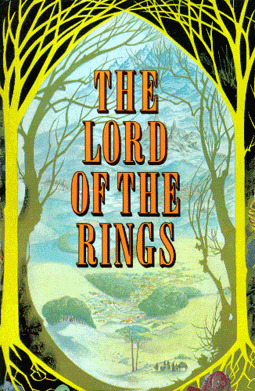
To review "The Lord of the Rings" is to review the air that fantasy literature breathes. Published in three volumes between 1954 and 1955 — "The Fellowship of the Ring," "The Two Towers," and "The Return of the King" — J.R.R. Tolkien's masterwork did not merely establish the template for modern fantasy; it created the very language, the iconography, the emotional grammar that the genre has spent seven decades either embracing or reacting against. Every elf, every dark lord, every quest to destroy an artifact of terrible power exists in dialogue with Tolkien, whether the author knows it or not.
The story is, at its heart, deceptively simple. Frodo Baggins, a hobbit of the Shire — small, comfort-loving, thoroughly unexceptional — inherits a ring of power from his uncle Bilbo. The ring, it transpires, is the One Ring, forged by the Dark Lord Sauron to dominate all other rings of power and, through them, the free peoples of Middle-earth. Frodo must carry the Ring to the fires of Mount Doom in the land of Mordor, the only place where it can be unmade, while Sauron's armies march to conquer the world.

But to describe "The Lord of the Rings" by its plot is to describe a cathedral by its floor plan. The glory of the work lies not in what happens but in how it is told — in the depth of the world that surrounds the narrative, in the languages that Tolkien invented (and the mythology he constructed to explain those languages), in the sense that Middle-earth extends infinitely beyond the edges of the page in every direction. When Aragorn sings of Beren and Lúthien on Weathertop, the reader feels the weight of thousands of years of history behind the words. When Gandalf speaks of the Balrog as a creature from "the ancient world," we understand instinctively that this is not empty backstory but the visible tip of an imagined history as rich and internally consistent as anything produced by academic historiography.
Tolkien's prose style is often criticized, and the criticism is not entirely unfounded. He writes with a formality that can feel archaic, even by the standards of the 1950s. His sentences are long, his descriptions lavish, his pacing — particularly in "The Fellowship of the Ring" — unhurried to the point of somnolence. The journey through the Old Forest and the encounter with Tom Bombadil test the patience of many first-time readers, and even devoted Tolkienists argue about whether these chapters earn their place in the narrative.
Yet Tolkien's prose, when it reaches its heights, achieves a beauty that no other fantasy writer has matched. The passage describing the approach to Lothlórien, the lament for Boromir, Théoden's charge at Pelennor Fields ("Arise, arise, Riders of Théoden!"), the breaking of the Witch-king's threat by Éowyn ("I am no man") — these are moments that transcend genre, that achieve the mythic resonance Tolkien consciously sought. He was a philologist who understood, at a cellular level, how the sounds and rhythms of English could be marshaled to create wonder, dread, sorrow, and triumph. When Tolkien's prose works, it works on a level that bypasses critical analysis and speaks directly to something ancient in the reader.

The characters of "The Lord of the Rings" have been criticized as archetypes rather than individuals, and there is some justice in this. Aragorn is the returning king, noble and unblemished. Gandalf is the wise guide. Legolas and Gimli represent their races in broad strokes. The women — Arwen, Éowyn, Galadriel — are powerful but peripheral, appearing in carefully circumscribed roles that reflect Tolkien's own traditional values and the conventions of the myths that inspired him.
But two characters escape this criticism entirely, and they are the ones that matter most. Frodo's gradual corruption by the Ring — his growing obsession, his isolation from his companions, his ultimate failure at the Crack of Doom — is one of literature's most convincing portraits of the corrosive effect of power on the unwilling bearer. And Samwise Gamgee, the gardener who becomes a hero not through martial prowess or magical ability but through stubborn loyalty and ordinary courage, is perhaps the most genuinely moving character in all of fantasy. "I can't carry it for you, but I can carry you," Sam tells Frodo on the slopes of Mount Doom, and in that line Tolkien distills his entire moral philosophy: that greatness is not the province of kings and wizards but of the small, the humble, the faithful.
Tolkien's moral vision has been both celebrated and criticized. The clear delineation between good and evil, the essentially conservative worldview (the Shire as pastoral paradise, industrialization as corruption, the rightful king restored to his throne), the absence of moral ambiguity among the protagonists — all of these have been identified as limitations by subsequent writers who sought to "deconstruct" or "subvert" the Tolkien template. George R.R. Martin, Joe Abercrombie, and R. Scott Bakker have all, in different ways, written against Tolkien's moral clarity, introducing antiheroes, moral relativism, and the grinding realities of medieval warfare into fantasy.
Yet there is something to be said for Tolkien's unfashionable certainty. In a genre now saturated with grimdark cynicism, the sincere conviction that mercy is stronger than cruelty, that small acts of kindness matter, that evil defeats itself through its own nature — these feel not naive but radical. Tolkien, who survived the Somme and wrote "The Lord of the Rings" through the Second World War, was not ignorant of evil. He understood it intimately. His choice to write a story in which goodness prevails was not a retreat from reality but a deliberate act of hope, rooted in his Catholic faith and his experience of a world that desperately needed hope.
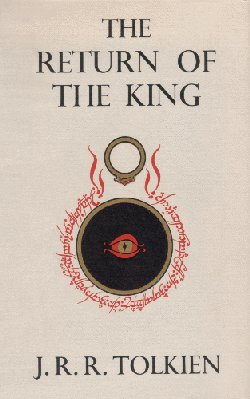
The influence of "The Lord of the Rings" on fantasy literature, film, gaming, and popular culture is so pervasive that it defies summary. Dungeons & Dragons, the foundation of modern tabletop and digital gaming, is essentially Tolkien translated into game mechanics. Peter Jackson's film trilogy (2001-2003) demonstrated that fantasy could command the biggest stage in cinema, winning seventeen Academy Awards and grossing nearly three billion dollars. Every fantasy novelist since 1954 has had to decide how to position themselves relative to Tolkien — to follow, to subvert, to ignore, to transcend — and the fact that this positioning remains necessary seventy years later is itself the strongest testament to the work's enduring power.
Reading "The Lord of the Rings" in the twenty-first century is an experience both familiar and strange. Familiar because its images and archetypes have become part of our cultural furniture — we all know what a hobbit looks like, what Mordor means, what "one ring to rule them all" signifies. Strange because the book itself is so much richer, slower, more contemplative, and more beautiful than the adaptations and imitations that have filtered its influence to mass audiences. The films gave us the spectacle; the book gives us the soul.
"The Lord of the Rings" is not a perfect novel. Its pacing is uneven, its characterization selective, its worldview constrained by its author's time and temperament. But it is a work of such imaginative generosity, such linguistic beauty, such moral seriousness, and such enduring emotional power that to criticize its flaws feels like complaining about the weather on a mountaintop. You did not come here for comfort. You came here for the view.
And the view, seventy years on, remains magnificent.